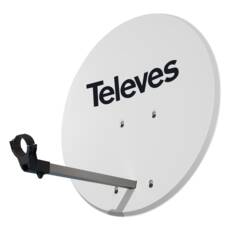

Televes Satellite Antenna

The Televes satellite antenna ISD series includes aluminium offset satellite dishes designed for satellite signal reception. The product family is available in two sizes, ISD 630 and ISD 830, both covering the 10.7-12.75 GHz frequency range. The ISD 630 provides 35.5 dBi gain, while the ISD 830 provides 38 dBi gain at 11.75 GHz. The reflector is made of aluminium, the LNB holder has a diameter of 40 mm, and the mast mounting system is suitable for masts with a diameter of 20-60 mm. Read more...

Change product view Order products by:
Filter products
By availability
On stock ()
Pre-order (2)
By brand
Televes (2)
By price
€ -
2 products in total, page 1: 1 - 2 / 21
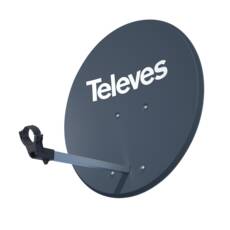
• Frequency range: 10.7 - 12.75 Ghz
• Material: Aluminium
• Gain: 35.5 dBi
• Offset angle: 26.2
• Dish size: Height 637 mm , weight 575
• Stainless steel reflector and screws
• Adjustable elevation angle from 0º to 90º
• An hex wrench is integrated in the LNB support itself for nut adjustment
• LNB-bracket diameter: 40 mm
• Colour: grey

Gross price (including 27% VAT): 80.55€ (Net price: 63.42€)

• Frequency range: 10.7 - 12.75 Ghz
• Material: aluminium
• Gain: 38 dBi
• Offset angle: 26.2
• Dish size: Height 833 mm , weight 747
• Stainless steel reflector and screws
• Adjustable elevation angle from 0º to 90º
• An hex wrench is integrated in the LNB support itself for nut adjustment
• LNB-bracket diameter: 40 mm
• Colour: white

Gross price (including 27% VAT): 99.92€ (Net price: 78.68€)
2 products in total, page 1: 1 - 2 / 21

Televes satellite antenna - ISD aluminium offset satellite dishes

The ISD series satellite antennas use an offset design with an aluminium reflector and stainless steel screws. The mechanical structure includes a flexible LNB holder and clamp made from special glass-fibre-reinforced polymer, an aluminium arm, and a Zamak clamp and support. Two U-bolts are included for mounting. The aluminium reflector and stainless steel screws provide resistance to corrosion.

Which satellite frequency range does the ISD series cover?

The ISD 630 and ISD 830 both operate in the 10.7-12.75 GHz frequency range for satellite signal reception. One of the key technical differences between the two sizes is gain: the ISD 630 provides 35.5 dBi and the ISD 830 provides 38 dBi at 11.75 GHz. The offset angle is 26.2 degrees for the ISD 630 and 26.6 degrees for the ISD 830. Both series use a 40 mm diameter LNB holder.

Televes ISD 630 satellite antenna with 35.5 dBi gain

The ISD 630 reflector is 637 mm high and 575 mm wide, while the overall product depth is 620 mm. The main product weight is 1600 g. Antenna gain is 35.5 dBi at 11.75 GHz, and the offset angle is 26.2 degrees. The specified elevation range is 0-90 degrees. The supported mast diameter is 20-60 mm and the LNB holder diameter is 40 mm. The documented wind load at 130 km/h is 278.4 N.

  • Frequency range: 10.7-12.75 GHz
  • Gain at 11.75 GHz: 35.5 dBi
  • Reflector size: 637 x 575 mm
  • Reflector material: aluminium
  • Offset angle: 26.2 degrees
  • Elevation: 0-90 degrees
  • LNB holder diameter: 40 mm
  • Mast diameter: 20-60 mm
  • Main product weight: 1600 g

How does the Televes ISD 830 satellite dish differ?

The ISD 830 uses a larger reflector measuring 833 mm in height and 747 mm in width, while the overall product depth is 660 mm. Its gain is 38 dBi at 11.75 GHz and its offset angle is 26.6 degrees. The main product weight is 2131 g. Most listed versions have an elevation range of 0-90 degrees, while Ref. 793103 is specified with a 20-60 degree range. Wind load is 499.2 N at 130 km/h and 686.4 N at 150 km/h.

  • Frequency range: 10.7-12.75 GHz
  • Gain at 11.75 GHz: 38 dBi
  • Reflector size: 833 x 747 mm
  • Reflector material: aluminium
  • Offset angle: 26.6 degrees
  • LNB holder diameter: 40 mm
  • Mast diameter: 20-60 mm
  • Main product weight: 2131 g
  • Wind load at 130 km/h: 499.2 N
  • Wind load at 150 km/h: 686.4 N

Aluminium reflector and corrosion-resistant construction

The ISD satellite antennas use an aluminium reflector and stainless steel screws. The LNB holder and clamp are made from special glass-fibre-reinforced polymer. The glass-fibre-reinforced plastic is resistant to corrosion, non-magnetic, flame-resistant and electrically insulating. Its low weight supports installation, while its flexibility improves the mechanical behaviour of the material under adverse weather conditions.

How are the LNB and coaxial cable positioned?

The LNB is installed in the 40 mm diameter holder, which can hold the LNB in position during installation without the use of a screw. A hex key for tightening the nut is integrated into the LNB holder. The internal design of the aluminium support arm allows the coaxial cable routing to be concealed inside the arm. The arm is installed using a single screw, while the reflector support connects to the elevation mechanism.

Mast mounting, elevation and mechanical installation

The ISD 630 and ISD 830 can be mounted on masts with a diameter of 20-60 mm. The mounting structure uses a Zamak clamp and support together with two U-bolts. The screws in the support are pre-assembled and protected against corrosion. The reflector mounting is supported by the design of the fixing holes, while the aluminium arm requires one screw for installation. The elevation mechanism is used to adjust the satellite dish.

Televes ISD satellite antenna advantages and key considerations

Advantages:

  • Aluminium reflector and stainless steel screws
  • Glass-fibre-reinforced polymer LNB holder and clamp
  • Coaxial cable can be routed inside the aluminium support arm
  • Integrated hex key in the LNB holder
  • Mounting on masts with a diameter of 20-60 mm
  • Orange, white and graphite colour versions within the product family

Key considerations: the ISD 630 and ISD 830 differ in reflector size, gain, offset angle, weight and wind load values. The documented specifications of the specific ISD version should therefore be considered when selecting the appropriate size.

Televes satellite antenna summary and FAQ

The Televes ISD series includes aluminium offset satellite dishes for the 10.7-12.75 GHz frequency range. The ISD 630 has a 637 x 575 mm reflector and 35.5 dBi gain, while the ISD 830 has an 833 x 747 mm reflector and 38 dBi gain. Both series use a 40 mm LNB holder, 20-60 mm mast mounting, an aluminium reflector and glass-fibre-reinforced polymer structural components.

  • Which frequency range do Televes ISD satellite antennas cover?
    The ISD 630 and ISD 830 cover the 10.7-12.75 GHz frequency range.
  • What is the gain of the ISD 630 antenna?
    The gain is 35.5 dBi at 11.75 GHz.
  • What is the gain of the ISD 830 antenna?
    The gain is 38 dBi at 11.75 GHz.
  • What LNB size is supported by the LNB holder?
    The documented LNB holder diameter is 40 mm for both series.
  • What mast diameter is supported?
    The supported mast diameter is 20-60 mm.
  • What material is the reflector made from?
    The reflectors of the ISD 630 and ISD 830 are made from aluminium.
  • Where can the coaxial cable be routed?
    The cable can be concealed inside the aluminium support arm.